
Portable Fire Extinguishers: A Procurement and Application Guide for Enterprises
Portable fire extinguishers have become essential fire safety equipment for households, enterprises, institutions, and public spaces due to their lightweight design, ease of operation, and rapid response capabilities. Compared to large fixed fire suppression systems, portable fire extinguishers offer superior mobility, flexible deployment, and broad applicability. They are particularly suited for initial suppression during sudden fires, enabling timely intervention to minimize or prevent fire-related losses.
This article provides an in-depth analysis covering technical principles, application scope, corporate value, and common procurement pitfalls. It aims to help enterprise users and managers understand the value of portable fire extinguishers while offering scientific guidance for selection and application.
I. Core Value of Portable Fire Extinguishers
Statistics indicate that the vast majority of fires can be effectively controlled or prevented if addressed within the initial 1-3 minutes, thereby minimizing or avoiding losses. In fire prevention and control, time is critical—and portable fire extinguishers are specifically designed for this “golden window.” Their key advantages include:
1. Lightweight and Easy Operation: Some models can be operated with one hand, while others require no specialized training for ordinary employees to use;
2. High Mobility: Typically weighing 1-9kg, portable fire extinguishers can be installed in confined spaces like vehicles, offices, or server rooms, allowing for quick retrieval upon detecting a fire;
3. Multi-scenario Applicability: Generally classified as ABC extinguishers, they cover common fire types including solids, liquids, and electrical fires.
For enterprise users, they are not only essential for regulatory compliance but also critical tools for ensuring production continuity and asset security.
II. Primary Types and Technical Characteristics of Portable Fire Extinguishers
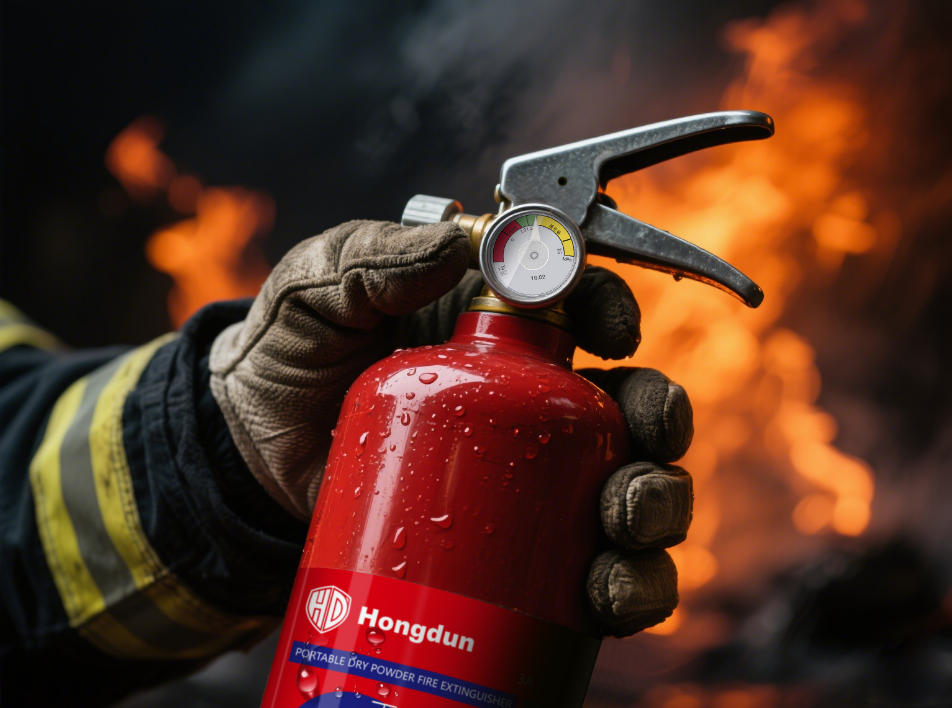
1. Dry Powder Portable Fire Extinguishers
Principle: Sprays ammonium phosphate or sodium bicarbonate powder to cover the burning surface, isolating it from air and interrupting the combustion chain.
Advantages: High extinguishing efficiency, suitable for Class A (solids), B (liquids), and C (gases) fires.
Limitations: Generates significant dust residue after use, making cleanup difficult and potentially contaminating precision equipment.
2. Portable Carbon Dioxide Fire Extinguishers
Principle: Releases pressurized liquid carbon dioxide that instantly vaporizes, depriving the fire of oxygen and lowering temperatures.
Advantages: Leaves no residue, does not damage precision instruments; suitable for server rooms, laboratories, and electrical equipment.
Limitations: Limited extinguishing capacity; unsuitable for windy outdoor environments.
3. Water-Based Portable Fire Extinguisher
Principle: Utilizes composite additives to impart cooling, smothering, and flame-retardant properties to water, while providing electrical insulation.
Advantages: Strong cooling capacity, suitable for solid and certain electrical fires.
Limitations: Limited capacity, less versatile than dry powder.
4. Aerosol Fire Extinguishers (Emerging Type)
Principle: Releases large quantities of extinguishing particles to interrupt combustion chemical chains.
Advantages: Compact and lightweight, easy to carry, suitable for vehicles, drones, battery compartments, etc.
Limitations: Primarily effective for confined space fires; limited efficacy in open environments.
III. Why Do Enterprise Users Need Portable Fire Extinguishers More?
Enterprise fire safety requirements differ from residential needs. Beyond personnel safety, they must consider production continuity, critical asset protection, and compliance management. Portable fire extinguishers deliver value in enterprise settings through two key aspects:
1. Minimizing economic losses from shutdowns and fires
In high-value settings like manufacturing plants and data centers, fires cause not only equipment damage but also production halts, supply chain delays, and customer losses. For instance, a one-hour shutdown of an electronics production line due to fire could result in losses exceeding hundreds of thousands of yuan. Rapid intervention to control or extinguish fires in their early stages can prevent prolonged shutdowns.
2. Safeguarding Critical Equipment and Data Security
Modern enterprises heavily rely on precision equipment and data systems. Damage to fire-compromised server rooms, automated production lines, or electrical control equipment in warehousing/logistics entails lengthy recovery periods and substantial costs. Portable CO₂ fire extinguishers rapidly suppress flames without leaving residues, minimizing secondary damage and maximizing data security.
IV. Technical Specifications and Procurement Considerations for Portable Fire Extinguishers
During procurement, managers often overlook technical details, compromising actual effectiveness. Key selection criteria include:
1. Fire Rating
Different countries use varying certification standards (e.g., EN3, UL, GB4351). Focus on the fire class ratings (A, B, C, D, F) labeled on extinguishers. For example, a 2A:10B:C rating suffices for most office environments.
2. Discharge Duration and Range
High-quality portable extinguishers should deliver 8–15 seconds of discharge with an effective range of 2–4 meters, ensuring users maintain a safe distance from flames.
3. Operating Temperature Range
For cold regions, select extinguishers functioning reliably at -20°C. High-temperature environments (e.g., metallurgical workshops) require heat-resistant casings and valves.
4. Container Material and Pressure Resistance
Cylinders must pass hydrostatic testing and feature corrosion-resistant coatings. Enterprises should require suppliers to provide inspection reports.
V. Common Misconceptions in Enterprise Fire Extinguisher Procurement and Management
Despite widespread adoption, significant misconceptions persist in corporate procurement and management practices, leading to equipment failure during critical incidents. The four most prevalent issues are:
1. Overreliance on Low-Cost Products
Some enterprises focus solely on price during procurement, neglecting fire extinguisher certifications, extinguishing agent performance, and after-sales service. This often results in unstable product quality or failure to pass fire safety inspections.
2. Neglecting Environmental Suitability
Standard water-based extinguishers remain in use in cold regions, leading to freezing and failure during winter.
Extinguishers with excessive plastic components are used in high-temperature workshops, posing a risk of bursting.
Businesses must consider operational environments when selecting equipment, verifying temperature ranges and pressure resistance specifications.
3. Inadequate Maintenance and Inspection
Even properly installed extinguishers fail if not regularly inspected and recharged. Common issues include low pressure, clogged nozzles, and expired extinguishing agents. Many fire accident investigations reveal that inadequate maintenance rendered extinguishers unusable during emergencies.
Though compact, portable fire extinguishers are among the most frequently used and practical tools in corporate fire safety systems. For enterprises, selecting and deploying portable fire extinguishers appropriately is not only a regulatory requirement but also a critical measure to reduce fire risks, ensure employee safety, and enhance corporate social responsibility.


Contact Us
If you have any questions about this Privacy Policy or our practices, please contact us:
Mobile: +86 13975129722
Email: robin@hongdunfire.com
Address: Room 29005, Wanda Building A, Changsha, Hunan, China
Related News
How to Distinguish Manufacturing Defects from Improper Valve Handling
Learn how to identify the real causes of fire extinguisher cylinder neck thread damage. Discover the differences between manufacturing defects, machining issues, transportation factors, and improper valve installation or removal. Includes expert insp

EN3-Certified Fire Extinguishers: Safety Assurance and Technical Analysis Under European Standards
EN3-certified fire extinguishers are at the core of European fire safety standards. This article details the standard system, performance requirements, applicable scenarios, and market value, helping to ensure safety and compliance.

What is the optimal size for a vehicle fire extinguisher?
This article primarily highlights the importance of vehicle fire extinguishers and provides size recommendations for different vehicle models, helping readers better select the appropriate size of car fire extinguisher.

Gas Fire Extinguishers Explained: Principles, Types, and Application Scenarios
Gas fire extinguishers play a key role in data centers, laboratories, power facilities, and other scenarios. This article explains their principles, types, application cases, and selection recommendations.